
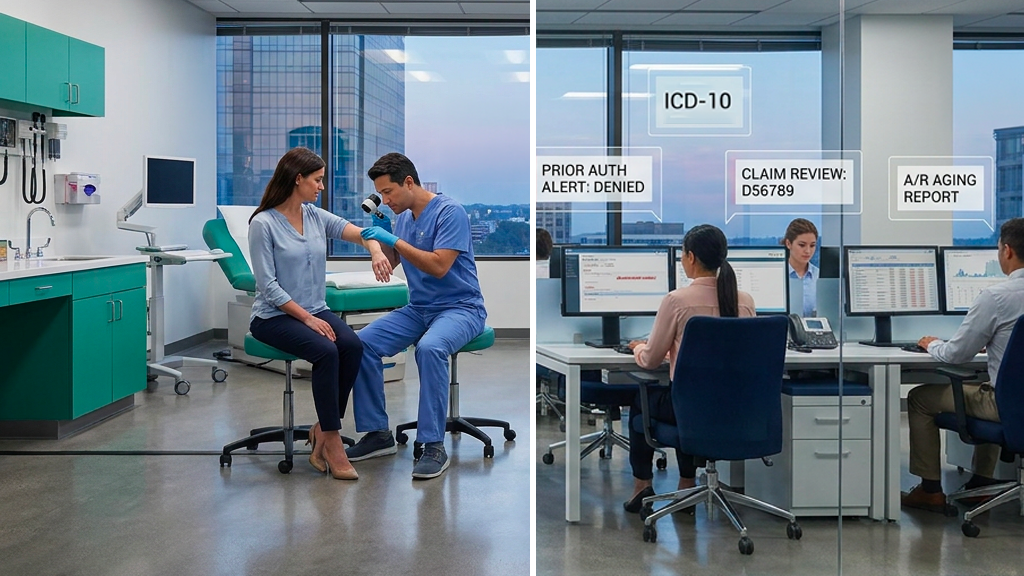
Dermatology billing is more complex than most outpatient specialties because it combines high-volume procedural coding, strict medical-vs-cosmetic separation, and size-based lesion measurement rules that create more opportunities for denials and underpayments.
Most specialties follow a predictable billing path: one visit, one claim, one set of codes. Dermatology doesn’t follow any of that.
A single encounter can produce 5–10 billable procedures, each requiring precise modifiers, lesion-specific measurements, and documentation that satisfies payer scrutiny across both medical and cosmetic service lines.
It’s why dermatology practices face denial rates of 18–22%, nearly double the 10–15% average in primary care.
The complexity isn’t accidental. It’s structural and identifying where it originates is the first step toward managing it effectively.
Table of Contents
Dermatology Billing Challenges Across Different Service Types
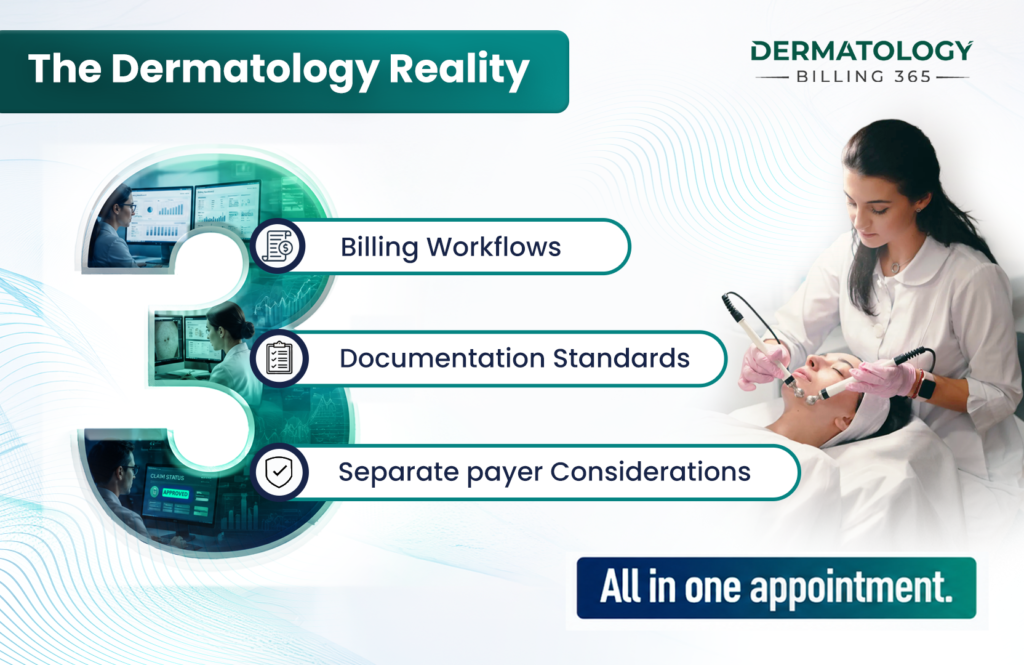
Dermatology doesn’t operate on a single billing track. Every day, a dermatology practice manages 3 distinct service categories simultaneously each with its own coding rules, documentation requirements, and payer behavior.
The moment all three appear in a single patient encounter, the complexity multiplies.
| Service Type | Billing Flow | Documentation Requirements | Complexity Driver |
| Routine care | E/M code → Diagnosis coding → claim submission | Medical necessity, visit level justification, diagnosis specificity | Modifier accuracy when procedures are added same-day |
| Surgical procedures | CPT selection → lesion measurement → modifier application → claim | Lesion size, anatomical site, margins, pathology linkage, medical necessity | Size-based code selection, multiple procedure rules, bundling risk |
| Cosmetic services | Procedure performed → patient self-pay → excluded from insurance claim | Signed cosmetic consent, separate financial documentation | Clean separation from medical claims, compliance risk if mixed |
What makes this unique to dermatology is that all 3 services regularly occur within a single patient visit.
For Example – A patient comes in for an annual skin check (routine E/M), has a suspicious mole removed and sent to pathology (surgical procedure), and asks about a cosmetic filler while they’re there (cosmetic service).
Compare that to
- Orthopedics, where a visit typically follows one path: procedure performed, operative note documented, CPT code selected, claim submitted, and
- Cardiology, where diagnostic and procedural billing is complex but doesn’t require separating insured medical care from self-pay cosmetic services in real time.
In dermatology, the billing team doesn’t just process claims, it actively manages the intersection of clinical, procedural, and cosmetic workflows on every single encounter.
Each intersection point is a potential denial risk. Understanding where those risks emerge is exactly what the following six challenges address.
Challenge 1: The E/M + Same-Day Procedure Problem
Billing an Evaluation and Management (E/M) service alongside a procedure on the same day is one of the most common and most denied patterns in dermatology.
To bill both, three conditions must be met:
- The E/M must address a separate clinical problem from the procedure.
- The provider must document distinct medical decision-making.
- Modifier 25 must be appended to the E/M code.
Without these three conditions, the E/M gets bundled into the procedure and denied.
Example: A patient comes in for wart removal (CPT 17110). The dermatologist also evaluates a new arm rash and prescribes a topical steroid. The practice bills 99213-25 and 17110. If the note doesn’t explicitly tie the E/M to the rash, not the wart, the modifier alone won’t protect the claim.
Challenge 2: Medical vs. Cosmetic Billing Overlap
No other outpatient specialty routinely sees patients for both insured medical care and self-pay cosmetic treatment in the same visit. This overlap creates documentation complexity that other specialties simply don’t face.
| Service | Medical Billing | Cosmetic Billing |
| Botox | Covered for hyperhidrosis with prior auth | Not covered for wrinkles |
| Mole removal | Covered if medically indicated | Denied if cosmetic |
| Laser therapy | Covered for psoriasis or vascular lesions | Not covered for pigmentation or wrinkles |
| Chemical peel | Covered for diagnosed acne scarring | Not covered for skin rejuvenation |
The billing rule is absolute: medical and cosmetic services require separate claims, separate documentation, and separate payment workflows.
Mixing them even unintentionally creates both denial exposure and compliance risk.
Challenge 3: High Patient Volume and Claim Complexity
Dermatology practices typically handle 30–40 patient encounters daily, nearly double the volume of most surgical specialties.
At that pace, documentation shortcuts become inevitable and billing errors that look minor in isolation multiply into significant revenue loss at scale.
The compounding effect moves through every stage of the revenue cycle.
- Rushed clinical notes mean missing lesion dimensions or incomplete medical necessity statements.
- Incomplete notes trigger coding errors à Coding errors generate denials.
- Denials extend AR days. Extended AR strains cash flow and adds administrative rework while new claims keep arriving at the same pace.
Even a 3% error rate across 800 monthly claims produces 24 denied claims. At an average value of $300–$500 per claim, that’s $7,200–$12,000 in delayed or lost revenue every month before appeals.
Challenge 4: Modifier Errors and Revenue Loss
Dermatology uses more modifiers per claim than most specialties and each one carries specific rules that vary by payer. The four most frequently misused:
- Modifier 25 — E/M on the same day as a procedure. Most common error: appending it without documentation of a distinct clinical decision.
- Modifier 51 — Multiple procedures in one session. Most common error: applying it to add-on codes, which are modifier 51-exempt.
- Modifier 59 — Distinct procedural service. Most common error: using 59 when Medicare’s NCCI requires a specific X-modifier (XE, XS, XP, or XU).
- Modifier 58 — Staged procedure during the postoperative period. Most common error: confusing it with Modifier 78 (return to OR) or 79 (unrelated procedure during global period).
The danger isn’t just outright denials. Modifier errors frequently pass through payer adjudication underpaid and practices never notice the revenue gap until an audit surfaces it.
Challenge 5: Documentation and Coding Accuracy
Dermatology coding is only as accurate as the clinical notes behind it. Unlike primary care, where a diagnosis code and visit level drive most claims, dermatology requires granular procedure-level details that directly determine reimbursement:
- Lesion size and anatomical site for excision and destruction codes
- Pathology references linking biopsy findings to diagnosis codes
- Medical necessity statements that distinguish covered treatment from cosmetic preference
- Procedure-specific details when multiple services occur in one session
When these details are missing or vague, payers either deny the claim outright or downcode it.
The revenue impact is immediate but the documentation gap that caused it often goes unaddressed, producing the same denial pattern on every subsequent claim.
Challenge 6: Payer Variability and Reimbursement Risk
Payer variability accounts for approximately 30% of dermatology claim denials making it one of the most significant and least controllable challenges in the specialty.
Take laser therapy for a vascular lesion, the same procedure, the same clinical indication, three completely different outcomes depending on the payer:
- One commercial payer covers it without restriction
- Another requires prior authorization before the procedure is approved
- A third excludes it entirely under their Local Coverage Determination (LCD) policy
The inconsistency runs across every payer tier:
- Medicare requires strict medical necessity documentation for excisions and biologics
- Commercial payers apply inconsistent cosmetic coverage rules that vary by plan and region
- Medicaid frequently mandates prior authorization for advanced dermatology treatments, adding administrative burden before a single claim is submitted
None of these rules are static. They update:
- Mid-year without direct notification to billing teams
- At contract renewal cycles
- With every new drug approval or LCD revision
A billing team managing dermatology without payer-specific rule libraries isn’t just working inefficiently. It’s generating preventable denials on every claim that hits a policy boundary it didn’t know existed.
Comparison Table: Dermatology vs. Other Specialties
| Billing Factor | Dermatology | Other Specialities |
| Procedures per visit | Often multiple (E/M, biopsy, excision, destruction) in a single encounter, each requiring separate CPT codes | Typically fewer procedures per visit, making coding simpler |
| Modifier Use | Heavy reliance on modifiers (25, 59, 51, 76) to distinguish services and avoid denials | Less frequent modifier use, with fewer coding conflicts |
| Medical Vs. Cosmetic Overlap | High — many procedures straddle medical necessity vs. cosmetic care, requiring strong documentation | Minimal overlap; most procedures are clearly medical |
| Patient Volume | Very high throughput; dozens of patients daily, magnifying the impact of small errors | Moderate patient volume; errors don’t scale as dramatically |
| Payer variability | Significant — Medicare, Medicaid, and commercial payers differ widely in dermatology coverage rules | Lower variability; payer rules are more standardized |
Practical Solutions to Overcome Dermatology Billing Challenges
Reducing denials requires a combination of clinical alignment, coding expertise, and technology-driven workflows.
- Specialty-trained coders — dermatology CPT codes, modifier rules, and lesion-specific documentation requirements need coders who work in the specialty daily, not generalists cross-trained on a cheat sheet.
- Structured EHR documentation templates — prompts for lesion size, anatomical site, medical necessity, and procedure details reduce the documentation gaps that cause downstream denials.
- Real-time claim scrubbing — automated edits catch modifier conflicts, missing diagnosis links, and invalid CPT combinations before submission, not after denial.
- Separated cosmetic and medical workflows — dedicated intake forms, financial policies, and payment collection for cosmetic services eliminate the compliance risk of mixed claims.
- Proactive payer monitoring — maintaining updated, payer-specific rule libraries for your top ten payers prevents the policy-mismatch denials that account for nearly a third of dermatology’s denial volume.
DermatologyBilling365: Purpose-Built for the Specialty’s Complexity
Dermatology billing is more complex than most specialties because it demands precision at every level coding specificity, modifier accuracy, medical-versus-cosmetic judgment, and payer-specific knowledge that changes constantly.
No general billing team is equipped to manage all of that without costly gaps.
Dermatology Billing 365 is built specifically for these demands with specialty-trained coders, real-time denial management, and updated payer intelligence in one purpose-built RCM solution.


FAQs
1. How do I know if I should use Modifier 25 or Modifier 59?
Use Modifier 25 for an E/M visit that’s separately identifiable from a minor procedure on the same day. Use Modifier 59 for distinct procedural services (different lesions, different sessions) that would otherwise be bundled.
2. What happens if I document a lesion as 1.0 cm but excise 1.1 cm?
You’re underbilling. Match the CPT code to the final excised size + margin, not the pre-op estimate. Document the exact measurement in your operative note.
3. Can I bill insurance for a cosmetic procedure if the patient also has a medical concern?
Yes, but you must separate the services. Bill the medical procedure to insurance with supporting documentation. Bill the cosmetic procedure directly to the patient with a signed ABN.
4. How often should I audit my dermatology claims for coding accuracy?
Audit 10% of claims monthly and review denial trends weekly. Focus on multi-procedure claims and cases with Modifier 25 or 59.
5. What is the fastest way to reduce dermatology denial rates?
Implement pre-submission claim scrubbing and payer-specific modifier matrices. These two steps alone can cut denial rates by 25–30% within 60 days.
