
Skin tags, also called acrochordons, are common benign growths that often develop on the neck, axillae, groin, eyelids, and other friction-prone areas. Billing becomes more complex when diagnosis coding, medical necessity, cosmetic exclusions, lesion counts, and payer requirements do not align.
For practices, accurate dermatology billing starts with selecting the ICD 10 code that reflects the documented lesion and confirming that the procedure and medical record support reimbursement.


Table of Contents
Importance of ICD 10 Codes for Skin Tags
ICD-10 CM coding identifies the condition that led to evaluation or removal. A valid diagnosis code alone does not make a skin tag procedure payable. The documentation must support both the diagnosis and the reason for treatment.
Accurate skin tag dermatology coding helps practices:
- Distinguish medically necessary treatment from cosmetic removal
- Reduce diagnosis and procedure mismatches
- Support payer medical necessity review
- Improve clean claim accuracy
- Identify noncovered cosmetic services
- Maintain consistency between the clinical record and claim
A useful dermatology coding principle is simple:
Code the condition documented by the dermatologist, not the diagnosis most likely to pass a payer edit.
Common ICD 10 Codes for Skin Tags
Several ICD-10 CM codes may appear in encounters involving skin tags or similar benign lesions, but they should not be treated as interchangeable.
| ICD-10 Code | Description | Coding Consideration |
|---|---|---|
| L91.8 | Other hypertrophic disorders of the skin | Commonly associated with ordinary cutaneous skin tags |
| D23.9 | Other benign neoplasm of skin unspecified | Benign skin neoplasm when appropriately documented |
| L98.8 | Other specified disorders of the skin and subcutaneous tissue | Applies to appropriately documented specified skin disorders |
| K64.4 | Residual hemorrhoidal skin tags | Specific to anal or residual hemorrhoidal skin tags |
Among these, L91.8 is commonly used for ordinary cutaneous skin tags. The remaining codes should be selected only when the dermatologist’s documentation supports the condition described by the code.
ICD-10 Codes Used in Skin Tag Billing
The term billable requires an important distinction. A billable ICD-10 CM code is sufficiently specific for claim submission. That does not mean every procedure reported with the code will be covered. Reimbursement still depends on documentation, medical necessity, patient benefits, and payer policy.
L91.8 Other Hypertrophic Disorders of the Skin
L91.8 is commonly used when the dermatologist documents an acrochordon or ordinary cutaneous skin tag.
When medical necessity affects coverage, the record should also document the clinical reason for removal, which may include:
- Recurrent bleeding
- Pain or tenderness
- Inflammation
- Repeated trauma
- Functional interference
CMS benign lesion guidance requires the medical record to clearly support the medical necessity for removal.
Coding Example
A patient has three pedunculated skin tags on the neck that repeatedly catch on clothing and bleed.
If the dermatologist documents the lesions as skin tags, L91.8 may represent the diagnosis. The note should separately describe the recurrent trauma and bleeding that explain why treatment was performed.
D23.9 Other Benign Neoplasm of Skin Unspecified
D23.9 describes another benign neoplasm of the skin when the site is unspecified.
It should not automatically replace L91.8 for a confirmed skin tag. If the dermatologist documents a benign neoplasm and the diagnosis fits this category, D23.9 may be relevant.
Where the documentation identifies a more specific site or condition, the most accurate supported diagnosis should be selected rather than defaulting to an unspecified code.
L98.8 Other Specified Disorders of the Skin and Subcutaneous Tissue
L98.8 is a broader diagnosis for other specified disorders of the skin and subcutaneous tissue.
It should not be used simply because a skin tag is inflamed, bleeding, genital, or located at another particular site. The provider must document a condition that appropriately supports L98.8.
K64.4 Residual Hemorrhoidal Skin Tags
K64.4 applies specifically to residual hemorrhoidal skin tags.
Appropriate: A documented residual hemorrhoidal or anal skin tag
Not appropriate: A routine cutaneous skin tag on the neck, axilla, eyelid, or another unrelated location
Codes Commonly Confused With Skin Tag ICD-10 Coding
Some valid ICD 10 codes describe benign skin conditions that can be confused with skin tags. These codes are billable, but they should not be used for an ordinary skin tag unless the documented diagnosis actually matches the code.
| Code | Condition | Why it Should Not Replace a Skin Tag Diagnosis |
|---|---|---|
| L72.3 | Sebaceous cyst | A cyst is clinically different from an acrochordon |
| L91.0 | Hypertrophic scar | Represents hypertrophic scar or keloid |
| L72.0 | Epidermal cyst | Represents an epidermal cyst rather than a skin tag |
A code can be valid for claim submission while still being inaccurate for the lesion being treated.
Skin Tag ICD-10 Coding by Location and Clinical Scenario
Location and symptoms can influence documentation and code selection, but they should not determine the diagnosis by themselves.
| Clinical Scenario | Potential Coding Consideration | Key Point |
|---|---|---|
| Neck | L91.8 may apply | Appropriate when documented as an ordinary cutaneous skin tag |
| Irritated skin tag | L91.8 | Used when the diagnosis remains a skin tag. |
| Inflamed lesion | Depends on documented diagnosis | May apply when documented as another specified skin disorder. |
| Eyelid | Diagnosis and site specificity matter | Do not default to D23.9 based only on location |
| Face | Diagnosis and site specificity matter | Code the documented condition and anatomical site |
| Axilla | L91.8 may apply | Common when documented as an acrochordon |
| Bleeding skin tag | Primary diagnosis plus clinical support | Bleeding alone does not automatically indicate L98.8 |
| Anal or perianal | K64.4 when appropriately documented | Applies to residual hemorrhoidal skin tags |
| Groin | L98.8 may apply | Appropriate when documented as an ordinary skin tag |
| Genital or labial | Depends on documented diagnosis | Do not default to L98.8 based on location |
The correct code is determined by the documented condition, not simply by whether a code appears on a payer’s benign lesion diagnosis list.
Key Factors in Billing for Skin Tag Removal
ICD-10 coding is only one component of a correctly submitted skin tag claim.
Medical Necessity
Asymptomatic skin tags removed for appearance are generally considered cosmetic.
When coverage is requested, documentation should explain the medical reason for removal, such as recurrent trauma, bleeding, pain, inflammation, or functional interference when applicable.
Lesion Count and CPT Coding
CMS guidance states that:
- CPT 11200 is reported with one unit for removal of up to 15 skin tags
- CPT 11201 is reported for each additional group of 10 lesions or part thereof
Quick Coding Example
| Lesions Removed | CPT Reporting |
|---|---|
| 12 | 11200 |
| 18 | 11200 plus one unit of 11201 |
| 27 | 11200 plus two units of 11201 |
The procedure note should contain an exact lesion count rather than simply stating that multiple skin tags were removed.
Diagnosis and Procedure Alignment
The ICD 10 diagnosis should describe the lesion actually treated.
A cyst, scar, or unrelated benign lesion diagnosis should not be paired with skin tag removal simply because both codes are individually billable.
Cosmetic Versus Covered Services
CMS considers benign asymptomatic lesion removal performed solely for cosmetic purposes noncovered. Payer rules should be verified before the procedure and the patient should understand potential financial responsibility.
Payer Requirements
Medicare Administrative Contractors and commercial health plans may apply different coverage and documentation requirements. A diagnosis accepted under one policy should not automatically be assumed to satisfy another.
Comparison of Appropriate and Commonly Misapplied ICD 10 Codes for Skin Tags
| Category | Codes Relevant when Documentation Supports Them | Codes Commonly Misapplied to Skin Tags |
|---|---|---|
| ICD 10 Codes | L91.8 D23.9 L98.8 when clinically appropriate | L72.3 Sebaceous cyst, L91.0 Hypertrophic scar, and L72.0 Epidermal cyst |
| Clinical Use | Must represent the documented lesion | Describe cysts scars or other conditions |
| Medical Necessity | Coverage depends on symptoms findings and payer criteria | A valid diagnosis does not make it appropriate for skin tag removal |
| Documentation | Should support lesion type location and reason for treatment | Creates risk when the diagnosis conflicts with the record |
| Coverage | Reimbursement depends on medical necessity, benefits, and payer policy | Claims may be denied when the diagnosis and procedure do not align |
| Special Situation | K64.4 may apply to residual hemorrhoidal or anal skin tags | K64.4 should not be used for routine skin tags elsewhere on the body |
| Cosmetic Removal | Follow applicable payer rules for noncovered treatment | Cosmetic removal should not be represented as medically necessary treatment |
The central distinction is whether the diagnosis accurately represents what the dermatologist documented and treated.
Top Coding Mistakes That Cause Skin Tag Claim Denials
Using L91.8 Without Medical Necessity Support
L91.8 may identify the condition, but it does not explain why removal should be covered.
Using Broad Codes When Documentation Is Incomplete
D23.9 and L98.8 should not become fallback codes simply because the note lacks specificity.
Confusing Skin Tags With Cysts or Scars
L72.0, L72.3, and L91.0 describe different conditions and should not substitute for a documented acrochordon.
Missing the Exact Lesion Count
CPT 11200 and 11201 depend on the number of lesions removed.
Billing Cosmetic Removal as Covered Care
A billable diagnosis does not convert an elective cosmetic procedure into medically necessary treatment.
Adding Symptoms Only to Obtain Coverage
Pain, bleeding, irritation, or other symptoms should appear on the claim only when supported by the encounter and coding rules.
Ignoring Payer Specific Rules
Coverage criteria can vary between Medicare jurisdictions and commercial health plans.
Modifiers Used for Skin Tag Removal in Medical Coding
Modifiers should reflect the documented circumstances rather than being routinely added to claims.
Modifier 25
Modifier 25 may apply when a significant and separately identifiable E and M service is performed on the same day as the skin tag procedure.
The modifier belongs on the E and M code. DermatologyBilling365 also provides detailed guidance on Modifier 25 dermatology billing.
Modifier GY
Modifier GY may be relevant to Medicare services that are statutorily excluded from coverage, including applicable cosmetic services. The claim circumstances and current CMS requirements should be verified before use.
Modifier GA
Modifier GA may apply when Medicare is expected to deny a service as not reasonable and necessary and a valid Advance Beneficiary Notice has been issued according to Medicare requirements. GA and GY should not be treated as interchangeable.
Modifier 59 and X Modifiers
Modifier 59 or an applicable X modifier may be appropriate when a truly distinct procedure is performed and documentation supports bypassing an applicable edit.
These modifiers should never be added simply to force a claim through a bundling edit
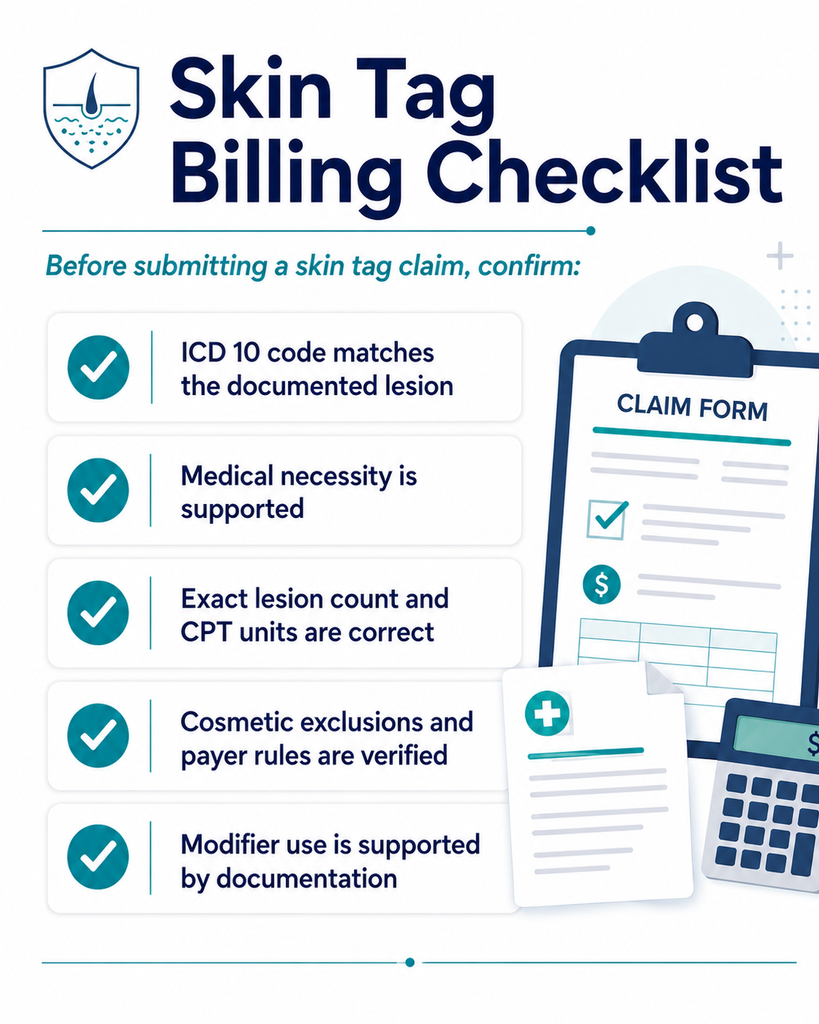
Skin Tag Billing Checklist
Before submitting a skin tag removal claim, confirm that:
- The lesion diagnosis is clearly documented
- The ICD 10 code matches the documented condition
- Medical necessity is supported when required
- The anatomical location is recorded
- The exact lesion count is documented
- CPT 11200 and 11201 units are correct
- Cosmetic exclusions have been identified
- Modifier use is supported
- Payer specific requirements have been checked
Building a More Reliable Dermatology Revenue Cycle
Skin tag billing becomes difficult when similar benign lesions, symptoms, cosmetic services, and payer requirements are treated as interchangeable. Strong claims keep diagnosis coding, lesion count, medical necessity, CPT reporting, modifiers, and documentation aligned.
DermatologyBilling365 helps dermatology practices strengthen coding accuracy, reduce preventable denials, and maintain more consistent reimbursement through specialty focused dermatology billing and coding support.
FAQs
1. What Is the ICD 10 Code for Skin Tags?
L91.8 Other hypertrophic disorders of skin are commonly used for skin tags. Code selection should reflect the dermatologist’s documentation and applicable payer requirements.
2. What CPT Code Is Used for Skin Tag Removal?
CPT 11200 is used for removal of up to 15 skin tags. CPT 11201 is reported for each additional group of 10 lesions or part thereof.
3. Does Insurance Cover Skin Tag Removal?
Coverage generally depends on medical necessity and the patient’s benefits. Removal of asymptomatic skin tags for cosmetic purposes is commonly noncovered.
4. What Code Is Used for Cosmetic Skin Tag Removal?
CMS guidance states that when a Medicare beneficiary requests submission of a claim for cosmetic benign lesion removal, Z41.1 is reported with modifier GY. Payer requirements should be verified before billing.
5. Can CPT 17110 Be Used for Skin Tags?
CMS distinguishes CPT 17110 and 17111 from skin tag removal codes. CPT 11200 and 11201 generally apply when the documented lesions are skin tags.
