

Dermatology practices often manage follow-up visits, new conditions, additional procedures, and postoperative care within the same global period, making accurate dermatology billing especially dependent on correct global surgery rules. The billing challenge is determining which services are included in the original procedure payment and which can be reported separately.
Modifiers 24, 57, and 79 help make that distinction. Modifier 24 applies to an unrelated E and M service during the postoperative period, modifier 57 identifies the initial decision for major surgery, and modifier 79 applies to an unrelated procedure performed during an existing global period.
Accurate use depends on the timing of the service, its relationship to the original procedure, the applicable global period, and the supporting documentation.
Understanding those differences can help dermatology practices avoid unnecessary bundling, modifier denials, and reimbursement delays.


Table of Contents
Modifiers 24, 57 and 79 Explained
Modifiers 24, 57, and 79 all relate to global surgery rules, but they do not describe the same situation.
| Modifier | What It Identifies | Applied To |
|---|---|---|
| 24 | Unrelated E and M service during a postoperative period | E and M code |
| 57 | Initial decision for a major surgery | E and M code |
| 79 | Unrelated procedure during the postoperative period | Procedure code |
The easiest way to separate them is by asking three questions:
- Modifier 24: Is this an unrelated visit during the global period?
- Modifier 57: Did this E and M service result in the initial decision for a major surgery?
- Modifier 79: Is this a new unrelated procedure occurring during another procedure’s global period?
The modifier should follow the documented clinical circumstances, not simply the fact that the payer has bundled or denied the service.
Modifier 24 in Dermatology Billing
Modifier 24 identifies an unrelated evaluation and management service performed during a postoperative period. Under Medicare guidance, the visit must be unrelated to the procedure that created the global period. Documentation should clearly establish why the new encounter is separate from routine postoperative care.
Example
A patient is still within the postoperative period following treatment of one condition and returns for evaluation of a newly developed inflammatory rash that is unrelated to the original surgery.
When the E and M service is medically necessary and clearly unrelated to postoperative care, modifier 24 may be appropriate on the E and M code.
Documentation Should Show
- The reason for the new visit
- Why it is unrelated to the original surgery
- Separate assessment and management
- Diagnosis supporting the unrelated condition
- Work performed during the E and M service
A different diagnosis can help demonstrate that the encounter is unrelated, but documentation should still tell the complete clinical story.
When Modifier 24 Should Not Be Used
Modifier 24 should not be used for routine postoperative care already included in the global surgical package.
Examples include:
- Routine wound checks
- Normal healing assessment
- Standard dressing changes included in postoperative care
- Suture removal when included in the global package
- Follow-up specifically related to the original procedure
- Management of expected postoperative recovery
Quick Rule
Related postoperative visit → usually part of the global package
Unrelated medically necessary E and M visit → modifier 24 may apply
The distinction should be established in the documentation before modifier 24 reaches the claim.
Modifier 57 in Dermatology Billing
Modifier 57 identifies an E and M service that resulted in the initial decision to perform major surgery. For Medicare, this generally applies when the associated surgical procedure has a 90 day global period. The modifier is appended to the E and M service, not the procedure.
Why the Decision Matters
An E and M encounter may involve evaluation of a condition and a discussion that results in the initial decision to proceed with major surgery.
When the requirements are met, modifier 57 distinguishes that decision-making encounter from routine preoperative work already included in the global surgical package.
The medical record should establish:
- The condition evaluated
- Relevant clinical findings
- Treatment considerations
- The decision for major surgery
- The relationship between the E and M service and planned procedure
Why Modifier 57 Is Less Common in Dermatology
This distinction is especially important for dermatology practices.
Many common dermatologic procedures are minor procedures with 0 or 10 day global periods. Medicare guidance states that modifier 57 is not used simply because an E and M service resulted in the decision to perform a minor procedure.
For minor surgery, the usual decision to perform the procedure is generally considered part of the preoperative work.
For example, if a dermatologist evaluates a benign lesion and decides during the encounter to perform a covered minor procedure, modifier 57 should not automatically be added to the visit.
When a significant and separately identifiable E and M service is performed on the same day as a minor procedure, modifier 25 may instead be relevant when its requirements are met.
This is one of the most important differences between modifier 57 and modifier 25.
Modifier 79 in Dermatology Billing
Modifier 79 identifies an unrelated procedure or service performed by the same physician during the postoperative period of another procedure. The modifier belongs to the new procedure code.
Example
A patient is within the postoperative period of a surgical procedure performed on one condition. During that period, the dermatologist performs a completely unrelated procedure for another condition.
If the second procedure is unrelated to the original surgery and coding requirements are met, modifier 79 may be appropriate.
Medicare guidance also states that a new postoperative period begins with the unrelated procedure reported with modifier 79.
Modifier 79 Documentation Should Establish
- The original procedure
- The existing postoperative period
- The new condition requiring treatment
- Why the new procedure is unrelated
- Anatomical and diagnostic details
- Procedure performed
Modifier 79 should not be added solely because the second service involves another CPT code.
Modifier 24 Versus Modifier 57 Versus Modifier 79
The most important difference is the type and timing of service.
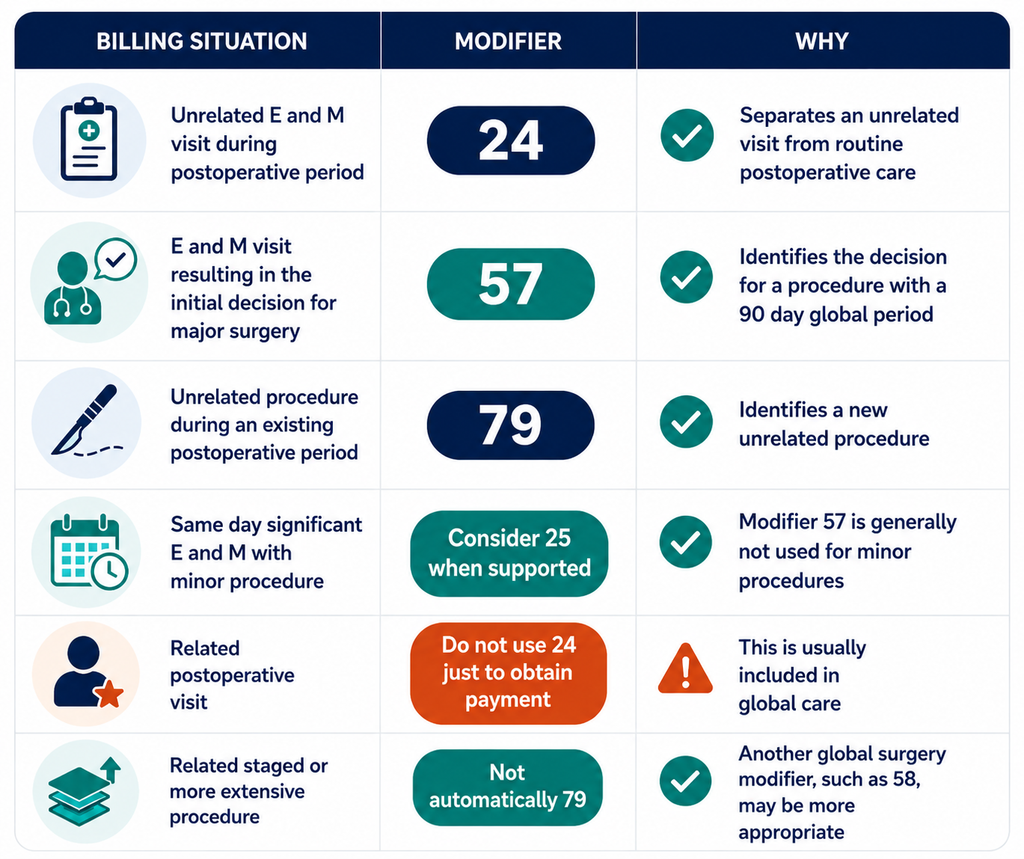
Practical Decision Path
Is the service an E and M visit?
If yes:
- Unrelated visit during postoperative period → consider 24
- Initial decision for major surgery → consider 57
Is the service a procedure during another procedure’s global period?
- If genuinely unrelated → consider 79
This distinction prevents one modifier from being used as a substitute for another.
Example – Modifier 57 Used Incorrectly
A dermatologist evaluates a lesion and performs a minor dermatologic procedure during the same encounter.
Adding modifier 57 simply because the procedure was decided upon that day would generally be inappropriate under Medicare rules.
The question instead becomes whether a separately identifiable E and M service exists and whether modifier 25 requirements are met.
Documentation Requirements for Global Surgery Modifiers
Modifier documentation should allow a payer to understand the relationship between the new service and the original procedure without relying on the modifier alone.
For Modifier 24
Document:
- Original surgical service
- Current postoperative status
- New unrelated condition
- Separate E and M assessment and plan
For Modifier 57
Document:
- Evaluation leading to the initial decision for surgery
- Medical necessity
- Major surgery status
- Timing of the E and M service
For Modifier 79
Document:
- Original procedure and postoperative period
- New unrelated diagnosis or condition
- Separate procedure
- Why the new treatment is unrelated
Clear documentation gives dermatology coding services the information needed to determine whether the service falls inside or outside the global surgical package. .
Common Coding Mistakes With Modifiers 24, 57 and 79
Using Modifier 24 for Routine Postoperative Care
Routine postoperative visits included in the global package should not be converted into separately payable E and M services simply by adding modifier 24.
Using Modifier 57 for Minor Dermatologic Procedures
Modifier 57 applies to the decision for major surgery, generally associated with a 90 day global period under Medicare.
Confusing Modifier 57 With Modifier 25
Modifier 57 identifies the initial decision for major surgery. Modifier 25 identifies a significant and separately identifiable same day E and M service associated with a minor procedure when supported.
Adding Modifier 79 to a Related Procedure
Modifier 79 requires the new procedure to be unrelated to the original procedure.
Ignoring the Procedure Global Period
Modifier selection should begin by checking whether the original or planned procedure has a 0 day, 10 day, or 90 day global period.
Using a Modifier Only Because a Claim Bundled
A denial or bundling edit does not itself justify modifier 24, 57, or 79.
Weak Documentation of Unrelated Services
Terms such as “different problem” or “new lesion” may not provide enough information to establish that the service falls outside the global package.
How to Reduce Global Period Modifier Denials
Before submitting a claim with modifier 24, 57, or 79, confirm the below:
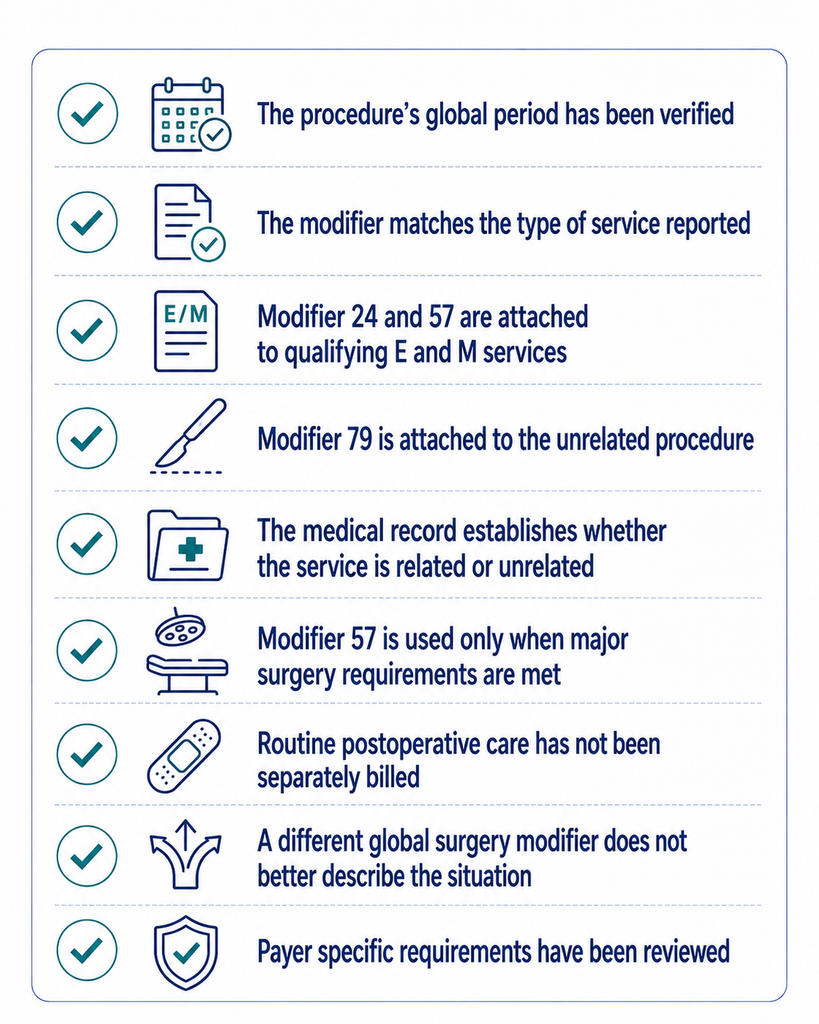
Modifier review should happen before claim submission rather than after a global-period denial.
What Dermatology Practices Should Know in 2026
The 2026 Medicare NCCI Policy Manual, effective January 1, 2026, continues to recognize modifiers 24, 57, and 79 as global surgery modifiers that may be used under appropriate clinical circumstances.
The main 2026 operational priorities are not new modifier definitions but consistent application of existing global surgery rules:
- Verify the global period before selecting a modifier
- Keep modifier 57 limited to qualifying major surgery decisions
- Distinguish unrelated visits from routine postoperative care
- Distinguish unrelated procedures from staged or related procedures
- Validate documentation before overriding global surgery edits
- Monitor commercial payer policies that may differ from Medicare requirements
For dermatology practices, this matters because the specialty regularly combines E and M services, lesion treatment, excisions, repairs, Mohs procedures, and postoperative care across different dates of service.
Strengthening Global Period Billing in Dermatology
Global surgery modifiers work only when the claim accurately reflects the timing and clinical relationship between services. Modifier 24 separates unrelated postoperative E and M care, modifier 57 identifies the decision for major surgery, and modifier 79 identifies a new unrelated procedure during a postoperative period.
DermatologyBilling365 helps dermatology practices manage these distinctions through specialty focused coding review, global period validation, modifier checks, and payer specific claim review. Denial management and root cause analysis also help identify recurring global-period errors before they continue affecting reimbursement.
By connecting documentation, coding, claim submission, and denial prevention, DermatologyBilling365 helps practices build more consistent and defensible dermatology billing workflows.
FAQs
1. What Is Modifier 24 Used for in Dermatology Billing?
Modifier 24 is used on an E and M service when a patient receives medically necessary care for a condition unrelated to the original surgery during the postoperative period.
2. When Should Modifier 57 Be Used?
Modifier 57 identifies the E and M service that resulted in the initial decision to perform major surgery. Under Medicare rules, it generally applies to procedures with a 90-day global period.
3. What Does Modifier 79 Mean?
Modifier 79 identifies an unrelated procedure or service performed during the postoperative period of another procedure. A new postoperative period begins with the unrelated procedure.
4. What Is the Difference Between Modifier 24 and Modifier 79?
Modifier 24 applies to an unrelated E and M service during a postoperative period. Modifier 79 applies to an unrelated procedure during that period.
5. What Is the Difference Between Modifier 57 and Modifier 25?
Modifier 57 relates to the initial decision for major surgery. Modifier 25 applies to a significant and separately identifiable E and M service performed on the same date as another procedure when its requirements are met.
