
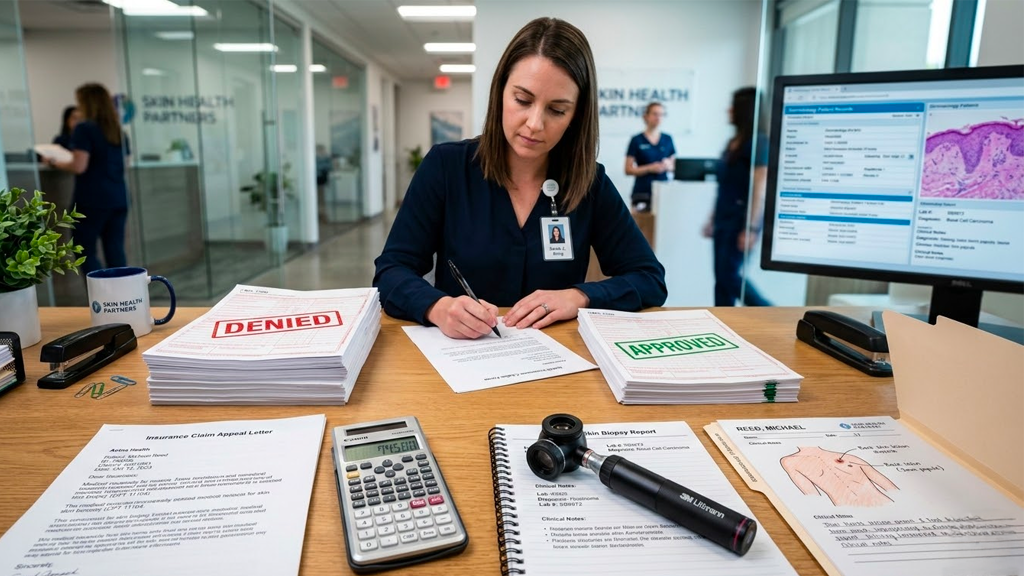
Dermatology practices provide a wide range of procedures, including biopsies, lesion removals, excisions, and advanced treatments. For these services to move smoothly through insurance reimbursement, claims must align with payer documentation standards, accurate coding, and coverage guidelines.
When a payer requests additional review, the appeal process creates an opportunity to present complete clinical documentation and reinforce the medical necessity of the service provided. With clear documentation and organized follow-up, appeals help ensure claims are evaluated with the full clinical context.
Implementing effective dermatology claim denials strategies supports accurate reimbursement, encourages faster payment timelines, and strengthens overall revenue cycle performance.
Table of Contents
Why Dermatology Claims Get Denied
Understanding the common causes of dermatology claim denials helps practices strengthen billing accuracy and improve reimbursement outcomes.
By identifying where denials typically occur, organizations can refine documentation, coding, and payer compliance. A proactive approach allows dermatology practices to reduce disruptions and support a more efficient revenue cycle.
- Documentation Errors and Missing Medical Necessity
Complete clinical documentation ensures alignment between diagnosis codes (ICD-10) and procedure codes (CPT). When documentation clearly establishes medical necessity, approval rates increase.
Checklist for documentation excellence:
- Detailed lesion size, location, and method
- Clear diagnostic reasoning
- Pathology correlation when applicable
- Biologic therapy justification
- Procedure-specific documentation templates
Structured documentation reduces medical necessity denials and strengthens appeals.
- Modifier and Coding Accuracy
Modifier precision plays a central role in dermatology reimbursement.
Key focus areas:
- Proper use of modifier -25 for separate E/M services
- Appropriate application of modifier -59 for distinct procedural services
- Accurate lesion counting and anatomical coding
- Alignment between CPT and ICD-10 codes
Coding clarity directly influences first-pass acceptance rates.
- Prior Authorization Management
Many dermatology treatments, particularly biologics and advanced therapies, require prior authorization. Organized tracking systems ensure approvals are secured before claim submission.
Effective prior authorization workflows include:
- Verification before scheduling
- Documentation checklists
- Real-time payer policy review
- Authorization expiration monitoring
A structured system supports smoother claim processing.
- Eligibility Verification and Patient Data Accuracy
Accurate patient demographics and insurance verification form the foundation of clean claims.
Front-end best practices:
- Same-day eligibility verification
- Secondary coverage validation
- Coordination of benefits confirmation
- Updated payer information collection
Front-desk precision strengthens downstream reimbursement performance.
- Timely Filing and Duplicate Claim Prevention
Timely submission guidelines vary by payer. Automated alerts and submission tracking ensure compliance. Duplicate claim monitoring prevents unnecessary rejections and maintains payer confidence.
Visual asset suggestion:
- Denial cause flowchart illustrating front-end, coding, and payer-level categories
- Denial checklist table for staff training
The Role of Appeals in Dermatology Revenue Cycle
Insurance appeals represent a structured process that allows providers to submit additional clinical clarification or documentation when a payer requests further review of a claim. Appeals ensure that dermatology services are evaluated with complete clinical context and accurate coding representation.
Purpose of Appeals in Revenue Cycle Management
Appeals serve several important functions within dermatology billing:
- Clarifying clinical documentation that supports medical necessity
- Confirming coding accuracy for procedural services
- Aligning submitted claims with payer coverage policies
- Ensuring that clinical care is evaluated with complete documentation
Through this process, appeals reinforce transparency between providers and payers while strengthening reimbursement accuracy.
When Appeals Become Necessary
Appeals typically occur when claims require additional clarification in areas such as:
- Medical necessity confirmation
- Modifier documentation
- Procedure classification
- Authorization validation
A well-prepared appeal ensures the payer has all relevant clinical and administrative information required to complete a thorough review.
The Value of Organized Appeal Workflows
Structured appeal systems improve revenue cycle outcomes by ensuring that every claim review request receives timely follow-up. Organized workflows also provide valuable insights into billing patterns, allowing practices to strengthen submission accuracy over time.
Dermatology Claim Appeal Workflow
An organized appeal process ensures that each claim receives a thorough review and appropriate documentation support. Dermatology appeal management typically follows several key stages.
Step 1: Denial Identification and Categorization
The appeal process begins with identifying claims that require additional review. Each claim is categorized according to the payer’s reason code.
Typical classification factors include:
- Payer reason code
- Procedure type
- Documentation category
- Authorization status
- Coding clarification needs
Categorization helps billing teams prioritize appeals and identify recurring trends.
Step 2: Root-Cause Analysis
After identifying the claim category, billing specialists review the claim to determine the underlying reason for the payer’s request for additional information.
Common evaluation areas include:
- Coding accuracy
- Documentation completeness
- Authorization verification
- Eligibility confirmation
- Payer policy alignment
Root-cause analysis ensures that the appeal submission addresses the specific issue identified by the payer.
Step 3: Appeal Documentation Preparation
A successful appeal submission includes clear clinical and administrative evidence supporting the claim.
Typical documentation includes:
- Complete medical records
- Procedure notes and clinical summaries
- CPT and ICD-10 code justification
- Relevant pathology or imaging reports
- Payer policy references when applicable
Organized documentation allows reviewers to understand the full clinical context of the service provided.
Step 4: Appeal Submission and Follow-Up
After preparing documentation, the appeal is submitted according to payer guidelines. Each payer maintains defined timelines and submission channels.
Efficient follow-up includes:
- Monitoring submission timelines
- Tracking appeal status updates
- Recording payer responses
- Escalating reviews when appropriate
Structured follow-up ensures appeals progress through the review process smoothly.
Strategies For Dermatology Appeal Success Rates
Effective appeal management relies on a combination of documentation clarity, coding expertise, and organized billing workflows. Implementing consistent strategies allows dermatology practices to strengthen reimbursement outcomes.
Maintain Structured Documentation Templates
Standardized documentation templates help physicians record important clinical details consistently.
Benefits include:
- Improved medical necessity documentation
- Faster clinical note review
- Clearer payer understanding of procedures performed
Templates create a reliable documentation structure that supports both initial claim submission and appeals.
Monitor Denial Trends Through Analytics
Regular analysis of denial trends provides insight into billing performance. Tracking patterns helps practices identify areas where documentation or coding processes can improve.
Useful analytics categories include:
- Denials by payer
- Denials by procedure type
- Denials by modifier usage
- Denials by diagnosis category
Data-driven insights strengthen billing strategy and improve claim accuracy.
Strengthen Coordination Between Clinical and Billing Teams
Collaboration between clinical staff and billing specialists ensures documentation supports coding requirements.
Effective coordination includes:
- Documentation education sessions
- Coding feedback loops
- Shared review of payer policy updates
Integrated teamwork improves claim quality and supports successful appeals.
Maintain a Payer Policy Reference Library
Insurance payers regularly update coverage policies. Maintaining an accessible reference library ensures billing teams can align claims with the latest requirements.
Policy libraries help teams:
- Verify coverage guidelines
- Support appeal arguments with policy references
- Improve claim accuracy during submission
How Dermatology Appeal Submissions can be Strengthened?
Well-structured appeal submissions help payer reviewers understand the clinical reasoning behind a dermatology procedure. A clear presentation of evidence strengthens the likelihood of reimbursement approval.
Create Clear Clinical Summaries
Appeals benefit from concise clinical summaries that explain:
- The patient’s presenting condition
- Diagnostic findings
- Treatment rationale
- Procedure performed
These summaries allow reviewers to quickly understand the medical context.
Align Coding With Clinical Documentation
Coding and documentation must support each other clearly. When procedure codes align directly with the documented diagnosis and treatment plan, the claim narrative becomes stronger.
Coding alignment ensures that:
- CPT codes reflect services performed
- Diagnosis codes support medical necessity
- Modifier usage accurately represents procedural details
Consistency across documentation and coding reinforces the appeal.
Reference Payer Coverage Guidelines
Including references to payer policies demonstrates that the claim aligns with coverage criteria. Policy citations help reviewers evaluate the claim according to established guidelines.
Supporting documentation may include:
- Coverage policy references
- Clinical guideline citations
- Documentation excerpts highlighting medical necessity
Clear policy alignment improves review clarity.
Use Organized Appeal Templates
Standardized appeal templates streamline the submission process while maintaining consistency across claims.
Effective templates include:
- Appeal summary section
- Clinical documentation highlights
- Coding justification
- Policy references
Structured templates improve submission quality and efficiency.
Dermatology claim appeals play an essential role in maintaining accurate reimbursement for complex clinical services. By combining structured documentation, precise coding practices, organized appeal workflows, and advanced revenue cycle technology, dermatology practices create a strong framework for managing payer reviews.
Strategic appeal management not only clarifies clinical information for payers but also strengthens long-term billing accuracy. When practices implement proactive denial prevention strategies alongside organized appeal processes, reimbursement cycles become more predictable, efficient, and sustainable.
A comprehensive approach to dermatology appeals supports consistent revenue performance while allowing clinical teams to focus on delivering high-quality patient care.
FAQs
1. How long does a typical dermatology claim appeal take to be reviewed by payers?
2. Are there limits on how many times a dermatology claim can be appealed?
Yes. Many payers allow multiple appeal levels, typically two or three. Each level requires additional documentation or clarification to support the original claim.
3. Which dermatology procedures most commonly require appeals?
Procedures that involve medical necessity review tend to generate more appeals, such as lesion removals, excisions, biopsies, and advanced therapies like biologic treatments.
4. Should dermatology practices appeal every denied claim?
Not always. Practices typically evaluate the financial value of the claim, the reason for denial, and the likelihood of success before deciding whether an appeal is worthwhile.
5. Can technology or automation help improve dermatology appeal management?
Yes. Many organizations use RCM platforms, denial management software, and analytics tools to track denial patterns, manage appeal timelines, and organize documentation more efficiently.


