
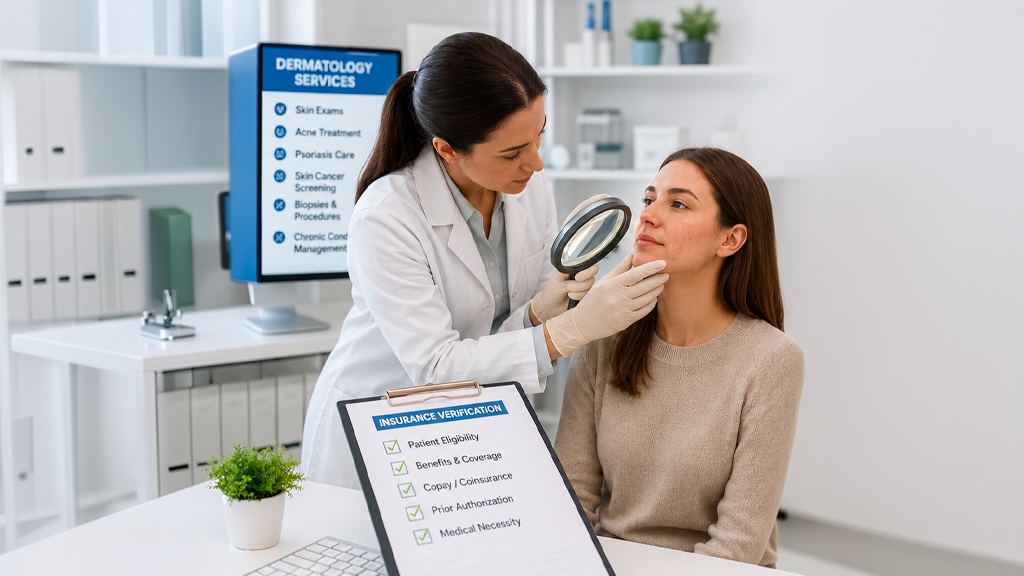
Dermatology insurance coverage in 2026 is more complex than it was two years ago, and the financial consequences of getting it wrong are growing. According to 2026 HFMA data, dermatology practices lose an average of 22% of recoverable revenue to coverage misunderstandings and incomplete documentation. For a mid-sized practice, that’s approximately $154,000 in preventable annual loss.
The root cause isn’t billing volume or staffing; it’s the widening gap between what payers require and what practices document. Payer-specific coverage variations, tightened medical necessity criteria, expanded prior authorization requirements, and 147 CPT code changes that took effect January 1, 2026, have created more claim failure points than most dermatology billing workflows are built to catch.
This guide covers which dermatology services insurance covers in 2026, what changed in payer policy this year, what medical necessity documentation payers now require, the most common denial triggers and how to prevent them, and the practical strategies that improve first-pass acceptance rates before claims are submitted.
Table of Contents
Does Health Insurance Cover Dermatology Services in 2026?
Insurance covers dermatology services but coverage depends entirely on diagnosis type, procedure intent, and payer-specific policy. The distinction that determines everything in dermatology billing isn’t the procedure itself. It’s whether the procedure is medically necessary or cosmetic in nature.
Coverage Depends on 3 Key Factors
| Factor | Covered Services | Non-covered Services |
| Diagnosis Type | Malignant lesions, autoimmune conditions, infections, precancerous changes | Cosmetic conditions, benign asymptomatic lesions, aging-related changes |
| Procedure Type | Excisions, biopsies, Mohs surgery, cryotherapy for medical conditions | Cosmetic excisions, laser hair removal, aesthetic treatments |
| Payer Policy | Medicare, Medicaid, commercial plans with medical necessity documentation | Procedures with cosmetic exclusions or no prior authorization on file |
What insurance typically covers:
- Cancer screening and treatment – BCC, SCC, melanoma
- Inflammatory conditions – eczema, psoriasis, acne with documented scarring
- Infectious diseases – warts, molluscum, fungal infections
- Autoimmune conditions – vasculitis, lupus skin manifestations
What insurance typically does not cover:
- Cosmetic procedures – Botox for aesthetics, fillers, chemical peels for rejuvenation
- Benign lesion removal without documented symptoms or functional impairment
- Sun damage treatment unless actinic keratoses are confirmed and documented
- Nail care for cosmetic reasons
Case Example:
A patient presents with a 1.5cm lesion on the forearm. Biopsy confirms basal cell carcinoma, insurance covers excision (11603) and pathology (88305). Same lesion, biopsy shows benign dermoid cyst, insurance denies excision as cosmetic. Same procedure. Different diagnosis. Completely different coverage outcome.
Verify insurance coverage and confirm medical necessity documentation before every dermatology visit, the benign vs. malignant diagnosis determines coverage more than any other single factor
Which Dermatology Procedures Are Covered by Insurance?
Coverage for specific dermatology procedures depends on procedure type, supporting diagnosis code, and payer-specific policies. Understanding which services payers reimburse and under what conditions, prevents the coverage-related denials that account for 22% of dermatology claims. .
Fully Covered Procedures (With Medical Necessity):
Diagnostic Services:
- Skin biopsies (punch, shave, incisional) – CPT 11102–11107
- Pathology services – CPT 88302–88309
- Dermoscopy with documented suspicious lesion – CPT 96931
Treatment Services:
- Lesion excisions (malignant) – CPT 11600–11646
- Mohs micrographic surgery – CPT 17311–17314
- Cryotherapy for malignant/premalignant lesions – CPT 17000–17004
- Photodynamic therapy for actinic keratoses – CPT 96913
Medical Management:
- Topical prescriptions for eczema, psoriasis, acne
- Systemic therapies (immunomodulators, biologics)
- In-office injections (corticosteroids for inflammatory conditions)
Not Covered -Cosmetic Exclusions:
Laser hair removal, cosmetic Botox, chemical peels for aging, cosmetic lesion excisions, and microdermabrasion carry no billable CPT codes for insurance purposes. These are patient-responsibility services requiring a signed financial agreement before treatment.
Scenario That Triggers Denial:
A patient requests removal of three asymptomatic benign back lesions. Provider excises all three and bills 11421 × 3. Payer denies as cosmetic procedure, no functional impairment or symptom documentation was included.
The fix: document symptoms, functional impact, or obtain a signed patient financial agreement before the procedure if coverage is uncertain.
Confirm payer-specific coverage policies for variable procedures (actinic keratoses, acne, psoriasis) before scheduling and obtain patient financial agreements for non-covered services.
Medical Necessity Requirements for Dermatology Insurance Coverage
Medical necessity documentation is the single most important determinant of dermatology insurance coverage. Even procedures that are clearly covered under a payer’s policy will be denied if the clinical record doesn’t establish why the treatment was medically necessary for that specific patient at that specific time.
Documentation requirements by condition:
Skin Cancer (BCC, SCC, Melanoma):
- Lesion size in centimeters
- Location with anatomical specificity
- Prior treatment history (recurrence status)
- Biopsy results confirming malignancy
- Functional impairment (if applicable)
Inflammatory Conditions (Psoriasis, Eczema):
- Severity (percentage of body surface area)
- Failure of conservative treatments first
- Functional impairment (pain, sleep disruption, activity limitation)
- Photos for baseline documentation
- Treatment timeline and response
Documentation Elements That Prevent Denials:
Every dermatology claim should be supported by: a specific ICD-10 code matching the procedure, lesion size and location, a medical necessity statement, documented failure of conservative treatment where applicable, and photographs or dermoscopy images when relevant.
Real-World Denial Case:
The provider treats psoriasis with biologic therapy. The claim was denied as “not medically necessary.” Reversal after submitting: 40% body surface area documentation, 3 failed conservative treatments, sleep disruption record, and photos.
CMS update: The 2026 Physician Fee Schedule Final Rule tightened medical necessity documentation requirements for inflammatory conditions. Payers now require explicit severity documentation and evidence of conservative treatment failure, general statements of medical necessity no longer satisfy audit review standards .
Build a medical necessity documentation checklist for each condition type and verify all elements are present before claim submission.
Common Dermatology Claim Denials
Dermatology claim denials rose 18% in 2026 compared to 2025, driven by stricter payer scrutiny, expanded prior authorization requirements, and updated CPT code bundling rules Understanding which denial types cost the most, and what prevents each one is what separates practices that manage denials reactively from those that prevent them systematically.
| Denial Reason | Frequency | Average Cost | Prevention Strategy |
|---|---|---|---|
| Medical necessity not established | 34% | $1,847/claim | Document severity + conservative treatment failure |
| Cosmetic procedure exclusion | 22% | $892/claim | Verify coverage before scheduling + patient financial agreement |
| Incorrect diagnosis-procedure mismatch | 18% | $1,245/claim | Match ICD-10 to CPT using NCCI edits |
| Missing prior authorization | 14% | $2,134/claim | Verify PA requirements at scheduling + track expirations |
| Bundling errors (unbundling) | 12% | $1,678/claim | Run NCCI claim scrubs before submission |
Financial Impact Analysis:
- Average dermatology denial: $1,589 per claim
- Average rework cost: $47 per denied claim
- 18% increase in denials = $154,000 annual revenue loss for mid-sized practice (100 denials/month)
Case example – diagnosis-procedure mismatch: A practice submits 11421 (benign lesion excision) paired with ICD-10 L99.9 (unspecified skin disorder). The payer denies it as cosmetic — the unspecified diagnosis doesn’t establish medical necessity. Correct pairing: 11421 + L92.0 (granulomatous disorder of skin) with symptom documentation. The procedure was appropriate. The diagnosis code didn’t tell the clinical story.
Implement pre-submission claim scrubbing that flags diagnosis-procedure mismatches, missing PA, and bundling errors before claims leave your practice — the majority of dermatology denials are preventable at the point of submission, not recoverable through appeal.
Dermatology Insurance Policy Changes You Must Know
Several significant changes affect dermatology insurance coverage in 2026 that practices must implement immediately.
Updated CPT Codes for Dermatology:
| CPT Code | Change | Impact |
|---|---|---|
| 11102–11107 | New biopsy code descriptors | Must use new codes for 2026, 11100–11101 deleted |
| 17000 | Expanded actinic keratosis coverage | Now covers chemical excision with documentation |
| 96913 | Photodynamic therapy updated | New insurance coverage requirements |
| 11600–11646 | No descriptor changes | Continue using — no action needed |
Medicare Policy Changes:
- Local Coverage Determination (LCD) updates require explicit severity documentation for inflammatory conditions.
- Prior authorization expanded in 7 states for dermatology procedures.
- Audio-only telehealth flexibilities extended through December 31, 2026 so that dermatology consultations may qualify.
Update your charge master and prior authorization workflows for 2026 CPT code changes and payer policy updates before submitting January claims.
Practical Strategies for Maximum Dermatology Reimbursement
Implement these 5 proven strategies to optimize your dermatology reimbursement and reduce dermatology claim denials.
Strategy 1: Verify Insurance Coverage Before Scheduling
Confirm payer-specific coverage policies for each planned procedure before the appointment is booked. Identify prior authorization requirements, medical necessity criteria, and any cosmetic exclusions that apply to the specific service.
Operational benefit: Eliminates coverage-related surprises at billing and allows the practice to obtain patient financial agreements before services are delivered — not after they’ve been denied. .
Strategy 2: Build Condition-Specific Medical Necessity Documentation Checklists
Create structured EHR templates for skin cancer, inflammatory conditions, actinic keratoses, and acne that prompt providers to document size, location, severity, conservative treatment history, and functional impairment at the point of care.
Operational benefit: Ensures every claim contains the documentation elements payers now require under the 2026 LCD updates — built into the clinical workflow rather than added retroactively after denial. .
Strategy 3: Implement Real-Time Claim Scrubbing
Configure billing software to flag diagnosis-procedure mismatches, missing prior authorizations, unbundling errors, and deleted CPT codes before claims are submitted.
Operational benefit: Catches the majority of preventable denials before they reach adjudication, significantly improving first-pass acceptance rates and reducing the rework cycle that compounds administrative burden monthly.
Strategy 4: Conduct monthly claim audits by denial category
Pull monthly reports organized by denial reason code and procedure type. Identify the top three denial categories by volume and revenue impact, and address root causes through workflow corrections rather than individual claim rework.
Operational benefit: Converts reactive denial management into a systematic improvement process that reduces first-pass denial rates measurably within two to three billing cycles. .
Strategy 5: Switch to real-time eligibility verification
Replace manual insurance calls with Real-Time Eligibility (RTE) technology to confirm benefits, deductible status, and patient responsibility before appointments.
Operational benefit: Eliminates eligibility errors, the fastest-growing source of preventable denials in 2026 as patient deductibles reach an average of $1,886 and patient financial responsibility increases with every plan renewal. .
Maximize Dermatology Reimbursement with the Right Billing Expertise
Navigating dermatology insurance coverage requires more than verifying patient eligibility. Practices must stay current with evolving payer policies, prior authorization requirements, medical necessity criteria, documentation standards, and coverage limitations that directly influence reimbursement outcomes.
Strengthening coverage verification processes, improving documentation accuracy, monitoring payer policy changes, and ensuring coding compliance can significantly improve first-pass acceptance rates and overall financial performance.
DermatologyBilling365 provides specialty-focused billing support designed specifically for dermatology practices. Our team helps providers navigate complex insurance requirements, reduce claim denials, improve reimbursement accuracy, and streamline revenue cycle operations. By combining dermatology-specific coding expertise with proactive denial prevention and payer-focused billing strategies, we help practices maximize collections while allowing providers to stay focused on delivering exceptional patient care.


FAQs
- Does Medicare cover dermatology biopsies?
Yes, Medicare covers dermatology biopsies (CPT 11102–11107) when performed for suspicious lesions with documented medical necessity. The biopsy must confirm malignancy or rule out cancer. Cosmetic biopsies for benign lesions without symptoms are not covered.
- What ICD-10 codes support dermatology insurance coverage for actinic keratoses?
Use L57.0 (actinic keratosis) with documentation of lesion count, location (face/ears/hands = higher risk), and sun exposure history. Medicare covers chemical excision (CPT 17000) when precancerous status is documented. Without medical necessity documentation, payers deny as cosmetic.
- Do commercial insurance plans cover acne treatment?
Coverage varies by plan. Most commercial payers cover acne treatment with scarring when conservative treatments (topicals) fail first. Document scarring severity, treatment timeline, and functional impairment. Cosmetic acne treatment without scarring is typically excluded.
- Is Mohs surgery covered by insurance for all skin cancers?
Mohs surgery (CPT 17311–17314) is covered for recurrent BCC/SCC, lesions >2cm, aggressive histology (morpheaform BCC, poorly differentiated SCC), or high-risk locations (face/scalp/ears). New, small, low-risk lesions may not meet medical necessity criteria for Mohs vs. standard excision.
- What documentation prevents dermatology claim denials for psoriasis biologics?
Document body surface area (typically >10%), failure of 2–3 conservative treatments (topicals, phototherapy), functional impairment (sleep disruption, pain, daily activity limitation), and photos for baseline. UnitedHealthcare now requires prior authorization for psoriasis biologics in 2026.
- How do I verify prior authorization requirements for dermatology procedures in 2026?
Check if your patient lives in CA, NY, FL, TX, PA, OH, or IL (7 states with expanded PA). Verify payer-specific requirements: UnitedHealthcare requires PA for biologics, Aetna for severe acne, Cigna for actinic keratoses. Use Real-Time Eligibility technology to automate PA verification before scheduling.
