

Modifier 59 is one of the most frequently misunderstood modifiers in dermatology billing. It can allow separately performed procedures to be recognized when an NCCI edit would otherwise bundle them, but inappropriate use can lead to denials, overpayments, recoupments, and audit exposure.
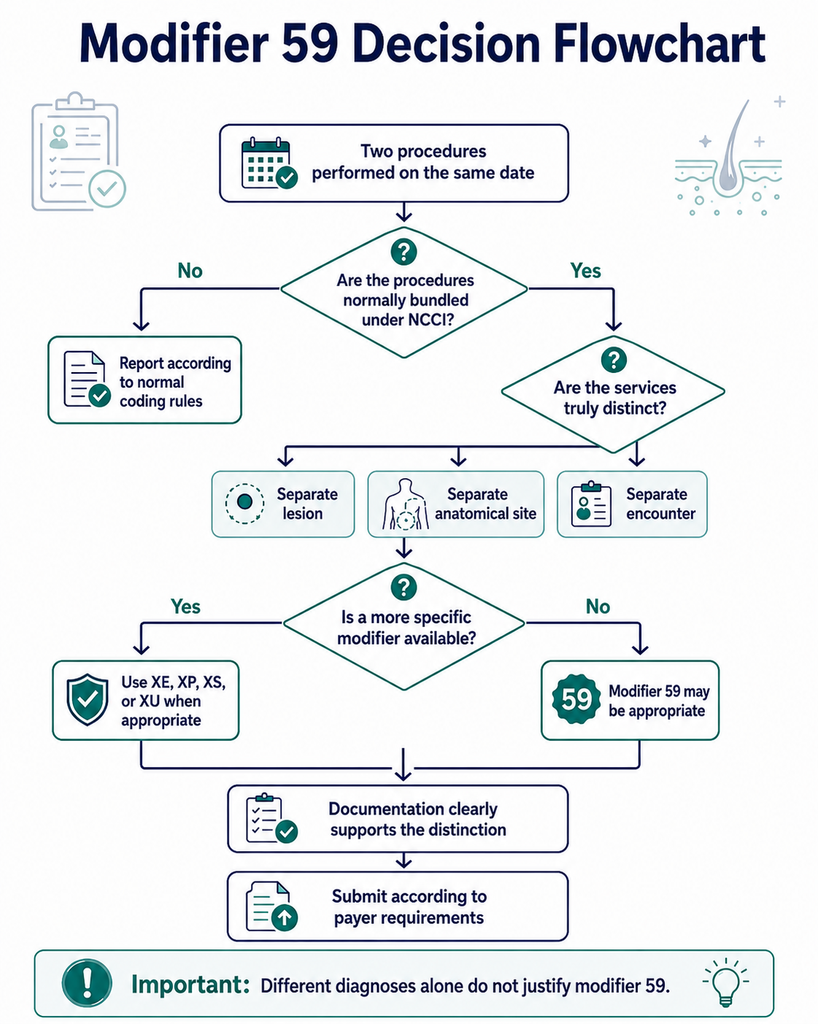
For 2026, Medicare NCCI guidance continues to define modifier 59 as a Distinct Procedural Service. Its primary role is to identify procedures performed at separate anatomical sites, on separate lesions when coding rules permit, or during separate encounters when no more specific modifier describes the circumstances.
For dermatology practices, the key question is not whether two procedures were performed on the same day. It is whether the documentation proves they were genuinely separate.


Table of Contents
Understanding Modifier 59 in Dermatology Billing
Modifier 59 tells the payer that two non E and M procedures that are normally bundled were distinct under the circumstances of the encounter. Under the 2026 Medicare NCCI Policy Manual, modifier 59 may be appropriate when documentation supports factors such as:
- Separate anatomical sites
- Separate lesions when coding rules allow separate reporting
- Separate patient encounters
- Separate incisions or excisions
- Distinct procedures that meet NCCI requirements
Modifier 59 should not be used simply because two CPT codes appear on the same claim. It should also not be used solely because the procedures have different diagnosis codes. CMS states that different diagnoses alone are not sufficient to justify modifier 59.
When to Use Modifier 59 in Dermatology
Dermatology encounters often include multiple lesions and different procedure types, making anatomical distinction especially important. Modifier 59 may be considered when:
Procedures Are Performed on Separate Lesions
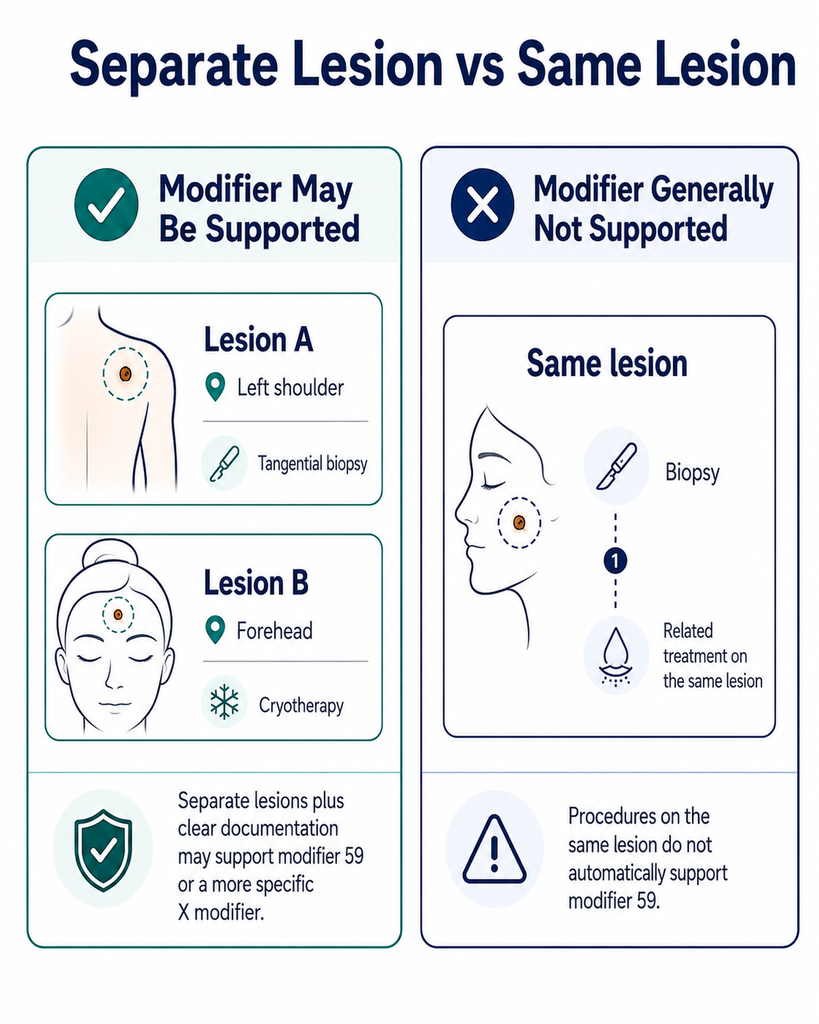
A dermatologist may biopsy one suspicious lesion and destroy a different lesion during the same encounter. If an NCCI edit bundles the procedure combination, modifier 59 may be appropriate when the documentation clearly establishes that the procedures were performed on separate lesions.
Procedures Occur at Separate Anatomical Sites
Two procedures may ordinarily bundle when performed together but qualify for separate reporting when performed at distinct anatomical sites. The note should clearly identify the location associated with each procedure.
Procedures Occur During Separate Encounters
A patient may receive one procedure in the morning and return later the same day for an unrelated service. When the procedures meet applicable dermatology coding rules, the separate encounter may support modifier 59 or the more specific XE modifier.
A Diagnostic Procedure Is Truly Separate
In limited circumstances, a diagnostic procedure performed before a therapeutic procedure may qualify for separate reporting if it provides the information needed to decide whether the therapeutic service should proceed and is not inherent to that service.
Examples of Modifier 59
Example 1 – One Biopsy and Destruction of Separate Lesions
A patient presents with:
- A suspicious pigmented lesion on the left shoulder
- An actinic keratosis on the forehead
The dermatologist performs a tangential biopsy of the shoulder lesion and destroys the forehead lesion.
CMS specifically states that NCCI edits between skin biopsy codes such as 11102 and destruction codes 17000 or 17004 may be bypassed with modifier 59, XE, or XS only when the procedures are performed on separate lesions or during separate encounters.
In this situation, separate lesion documentation may support the applicable modifier.
Example 2 – Procedures on Different Anatomical Sites
A dermatologist performs one procedure on a lesion of the arm and another distinct procedure on a noncontiguous lesion of the face.
If an NCCI edit exists and the procedures satisfy separate reporting rules, documentation of the two distinct anatomical sites may support modifier 59 or XS.
Example 3 – Separate Same Day Encounter
A patient undergoes a dermatologic procedure in the morning and returns later for a distinct service unrelated to the first procedure.
When the services qualify for separate reporting, XE may provide a more specific description than modifier 59.
When Modifier 59 Should Not Be Used
Modifier 59 generally should not be used when:
- Procedures are performed on the same lesion and normally bundle
- One service is integral to another
- Different diagnoses are the only basis for separate reporting
- Documentation does not establish separate sites or encounters
- A more specific modifier applies
- The modifier is being used only to bypass an NCCI edit
Modifier 59 Vs. Modifier 25
Modifier 59 and modifier 25 serve different purposes.
| Modifier | Used For | Typical Dermatology Situation |
|---|---|---|
| 59 | Distinct non E and M procedural services | Separate lesions or anatomical sites |
| 25 | Significant and separately identifiable E and M service | Office visit plus a separately reportable procedure |
For example, if a dermatologist evaluates a new rash and separately performs cryotherapy on an unrelated lesion, modifier 25 may apply to the E and M service when the documentation supports significant additional work.
Modifier 59 is not a substitute for modifier 25. Dermatology practices can review the separate requirements in the Modifier 25 dermatology billing guide.
Modifier 59 Vs. XE XP XS and XU
CMS created the X modifiers to provide greater specificity when a distinct procedural relationship can be described more precisely.
| Modifier | Description | Potential Use |
|---|---|---|
| XE | Separate encounter | Same date but separate encounter |
| XP | Separate practitioner | Service performed by a different practitioner |
| XS | Separate structure | Distinct anatomical site or structure |
| XU | Unusual nonoverlapping service | Service does not overlap usual components of another service |
| 59 | Distinct procedural service | Used when no more specific modifier appropriately describes the circumstances |
The 2026 NCCI guidance states that modifier 59 should be used only when another established modifier does not better explain the relationship between the services.
Payer acceptance of the X modifiers can vary, so payer specific requirements should be checked before claim submission. Before using modifier 59 or XS, practices should also check whether a more specific anatomical modifier accurately identifies the distinct site.
Modifier 59 and Skin Biopsy Coding
Skin biopsy and lesion treatment combinations are a common source of modifier 59 errors. CMS specifically addresses NCCI edits involving:
- 11102 tangential biopsy
- 11104 punch biopsy
- 11106 incisional biopsy
- 17000 and 17004 lesion destruction
Modifier 59, XE, or XS may be appropriate when the biopsy and destruction are performed on separate lesions or during separate encounters.
Example
Weak documentation
Biopsy performed and AKs treated.
Stronger documentation
Tangential biopsy performed on a 6 mm irregular pigmented lesion of the left upper arm. Cryotherapy performed separately on two actinic keratoses of the forehead.
Modifier 59 in Mohs Surgery Billing
Modifier 59 also requires careful use when Mohs surgery and biopsy services occur on the same date.
CMS guidance states that modifier 59 is generally not appropriate when the biopsy and Mohs surgery involve the same lesion during the same operative session.
There are limited situations in which separate biopsy reporting may be appropriate, including when:
- A separate lesion is biopsied
- Diagnostic confirmation is required before proceeding with Mohs under applicable rules
- Prior pathology cannot reasonably be obtained and payer requirements are met
When a diagnostic biopsy qualifies for separate reporting with Mohs surgery, the applicable modifier should follow the specific code pair, NCCI edit, and payer requirements. Modifier 59 should not be automatically appended to the Mohs code simply to obtain separate payment.
Documentation Requirements for Modifier 59
Modifier 59 should be supported by documentation that clearly demonstrates why the services were distinct. A strong dermatology record should identify:
- Each lesion separately
- Exact anatomical location
- Procedure performed on each lesion
- Diagnosis associated with each lesion when relevant
- Whether encounters occurred separately
- Why each procedure was independently necessary
- Distinct operative or procedural work
Common Modifier 59 Coding Mistakes in Dermatology
Adding Modifier 59 Automatically When Two Procedures Are Billed
Multiple procedures on the same claim do not automatically represent distinct services.
Using Different Diagnoses as Justification
CMS explicitly states that different diagnosis codes alone do not support modifier 59.
Using Modifier 59 on the Same Lesion
When two procedures occur on the same lesion and one is integral to the other, modifier 59 generally does not make them separately payable.
Failing to Document Anatomical Sites
Terms such as “multiple lesions treated” do not adequately demonstrate which procedure belongs to which lesion.
Confusing Modifier 59 With Modifier 25
Modifier 59 applies to non E and M procedures. Modifier 25 applies to a separately identifiable E and M service.
Ignoring More Specific X Modifiers
XE, XP, XS, or XU may describe the circumstances more accurately than modifier 59.
Using Modifier 59 to Force Payment
An NCCI edit does not automatically mean a modifier should be added.
Some edits do not permit modifier override, and others require very specific clinical circumstances.
Applying Modifier 59 Without Checking Payer Rules
Commercial payer and Medicaid requirements may differ from Medicare processing rules.
How to Reduce Modifier 59 Denials
Before submitting a dermatology claim with modifier 59, confirm:
- An NCCI edit actually exists or modifier reporting is otherwise required
- Both procedures qualify for separate reporting
- Separate lesions, sites, or encounters are clearly documented
- The procedures are not integral components of one another
- A more specific anatomical or X modifier does not apply
- Modifier 59 is attached to the appropriate procedure code
- Payer specific requirements have been checked
- Confirm the NCCI edit permits a modifier override
The modifier should be the final result of the documentation and coding review, not the starting point.
What Changed for Modifier 59 in 2026
For 2026, dermatology practices should continue to apply modifier 59 conservatively. Current CMS NCCI guidance reinforces that more specific X modifiers should be used when they better describe why services are distinct.
Key controls include:
- Use XE for a genuinely separate encounter
- Use XP for a separate practitioner when applicable
- Use XS for an appropriate separate structure or anatomical circumstance
- Use XU for an unusual nonoverlapping service
- Use modifier 59 only when a more specific modifier does not describe the situation
- Verify whether a specific anatomical modifier is more appropriate before using 59 or XS
- Do not use different diagnosis codes alone as justification
CMS’s 2026 Medicare NCCI manual explicitly states that different diagnoses are not sufficient criteria for modifiers 59, XE, or XS. The procedures generally remain bundled unless performed at separate anatomical sites or separate encounters.
Strengthening Modifier Accuracy in Dermatology Billing
Modifier 59 can support appropriate reimbursement when dermatology procedures are genuinely distinct, but it should never be treated as a routine edit bypass. Accurate reporting depends on clear lesion documentation, anatomical separation, NCCI review, and payer specific requirements.
DermatologyBilling365 helps dermatology practices strengthen modifier accuracy through specialty focused coding review, documentation validation, and payer specific claim checks. The team also supports denial management and root cause analysis to identify recurring modifier errors before they continue affecting reimbursement.
By connecting coding, claim submission, and denial prevention, DermatologyBilling365 helps practices build more consistent and defensible dermatology billing workflows.
FAQs
1. What Does Modifier 59 Mean in Dermatology Billing?
Modifier 59 identifies a distinct non E and M procedural service when procedures that are normally bundled are separately reportable under the circumstances.
2. When Should Modifier 59 Be Used in Dermatology?
It may be appropriate for procedures performed on separate lesions, at separate anatomical sites, or during separate encounters when coding and payer rules support separate reporting.
3. Can Modifier 59 Be Used for Different Diagnosis Codes?
Different diagnoses alone do not justify modifier 59. Documentation must establish that the procedures themselves were distinct.
4. What Is the Difference Between Modifier 59 and Modifier 25?
Modifier 59 applies to distinct procedures. Modifier 25 applies to a significant and separately identifiable E and M service performed on the same date as another service.
5. Can Modifier 59 Be Used for a Biopsy and Cryotherapy?
It may be appropriate when the biopsy and destruction are performed on separate lesions and applicable NCCI rules permit separate reporting.
